Is Russia ready to start war with Turkey in Syria?

2020/02/20

Flirtation with Turkey turned out to be disastrous for Russia, but as long as Russia is in the game, the stakes should be high, orientalist Semyon Baghdasarov said.

Turkey is ready to start a military operation in Idlib

Turkish President Recep Tayyip Erdogan, speaking to members of the ruling Justice and Development Party, said that Ankara was ready to start a military operation in Idlib.

"If the countries that we are in negotiations with do not do what needs to be done in Idlib, then we will do it ourselves. For the time being, we do not see the result that we want from these talks. We are fully prepared for our own operation in Idlib, it's only a matter of time, we can start at any moment. This is a vital operation for us," Erdogan said.

He added that he discussed Turkey's possible actions with US President Donald Trump over the phone.

This is the worst scenario in Russia-Turkey relations

In September 2018, Russia and Turkey agreed to create a demilitarized zone in Idlib, where more than a dozen different armed groups are located. However, Turkey did not meet the requirement for the disarmament of the radical groups that would constantly attack the positions of the Syrian Arab Army (SAA) and civilians. At the end of January, the SAA launched an offensive in Aleppo province, the province has been liberated along with a half of the province of Idlib, and 13 out of 30 Turkish observation posts found themselves encircled.

Vladimir Putin's pfficial spokesman, Dmitry Peskov, said that the possible operation against Syria would be the worst-case scenario.

Is Russia ready for war with Turkey?

Semyon Baghdasarov, the director of the Center for the Middle East and Central Asia, told Pravda.Ru that there are already 7,000 members of the regular armed forces of the Turkish army and over 2,000 units of armored vehicles in Idlib.

"Erdogan is ready to start. Is Russia ready? This is the most interesting question. I think that flirting with Turkey was a mistake. I think that all people who work in the Turkish direction should be fired from their jobs. This is a debacle," said expert.

According to Semyon Baghdasarov, not to deeply involved in the conflict, Russia is supposed to  give the Syrian leadership an opportunity to urgently agree with the branch of the Kurdistan Workers Party, the Democratic Union Party, which has a military wing fighting in Syria (YPG), to form a separate corps.

In fact, this can be done quickly, which will dramatically increase the combat capability of the Syrian army. Russia must help with military hardware, the expert said. If Erdogan openly intervenes in the intra-Syrian struggle, then Syria should intervene in the intra-Turkish agenda in order to:

  •     support the Kurdistan Workers Party;
  •     support various Marxist-Leninist local groups;
  •     claim the return of the Sanjak of Alexandretta, which was illegally taken in 1939.

    "We need to play big, as Erdogan plays, otherwise we will lose," Semyon Baghdasarov said.

In 1939-1940, the Sanjak of Alexandretta, a multinational region that turned into an ethnically homogeneous Turkish Iskenderun, was taken away from Syria.

The situation in Idlib is explosive

According to a Russian source in military-diplomatic circles, despite statements about the desire to resolve the situation in Idlib by diplomatic methods, Ankara deploys military personnel, weapons and military hardware to the "de-escalation zone". There are more than 70 tanks, about 200 armored combat vehicles and 80 field artillery guns in the area. On February 1, 2020, when neutralizing an attempted offensive of terrorists into a district of Aleppo, four FSB officers of Russia, who were in Syria on a business trip, were killed.

In Idlib, militants use US-made man-portable air defense systems (MANPADS). Over the past ten days, two helicopters of the Syrian army were shot down.

The talks in Moscow with the Turkish side on February 17 ended without any results. The parties have failed to come to a new agreement on the crisis in Idlib.

Let's block ads! (Why?)

Читать далее ...

Putin speaks about special operation to replace Medvedev’s government

2020/02/20

Vladimir Putin said in his recent interview with TASS news agency that the former chief of the Federal Tax Service, Mikhail Mishustin, was not initially on the list of four candidates for the new prime minister. The resignation of Dmitry Medvedev's government was not a "special operation", and the tandem with Dmitry Medvedev did not break up either.

In the interview, which was held in a new format elaborated specifically for social networks, TASS observer Andrei Vandenko asked 20 questions to President Putin. The number of questions coincided with the number of years, which Putin has been staying in power in Russia.

Putin did not agree with the assumption that the resignation of Medvedev's government, which took place an hour after the announcement of Putin's Address to the Federal Assembly on January 15, was carried out as a special operation. When the interviewer noted that the reshuffling made many believe that it was all done in a rush, Putin said that Russia was not Belgium: it is impossible to dissolve the government and then live without a government for a whole year. "Would it be better to dismiss the government, and then form it for six months? Can you imagine what it would lead to?" Putin said.

Medvedev knew he would be sacked

"Such a situation should never happen - everything should be done calmly, one should think through every step, have all the preparations done and then make the decision and implement it," he said. According to Putin, Medvedev knew in advance about the upcoming resignation of his government. However, the president refused to specify when he made the decision to dissolve Medvedev's cabinet.

"We have a very open and friendly relationship with Dmitry Medvedev. We have no secrets from each other. Therefore, we discussed this [resignation]," Putin said. He assured that his tandem with Medvedev did not break up: "We work with Dmitry Medvedev as before." Putin did not agree with the fact that a new position was set up for Medvedev quickly - deputy head of the Security Council.

Putin called not to compare this post with the post of the vice president, as the leader of the Liberal Democratic Party, Vladimir Zhirinovsky, suggested.

"The vice president "replaces the president in the totality of his rights and obligations," and Medvedev is only Putin's deputy within the scope of the Security Council.

The news of the interview was the story about four candidates who were proposed for the post of the new Prime Minister of the Russian Federation. Putin did not disclose who exactly proposed them to the president and what other names were on the list. Interestingly, Mikhail Mishustin was not among them, and no one pointed out his name to Putin - the president picked him himself. The President emphasized that proposing Mishustin's candidacy was his personal decision.

"He is a real expert in his field. He is a good practitioner who understands what needs to be done, he knows how to do it, and he does it to achieve specific results, "the president explained.

He called "very primitive" the idea that people from the tax service, which is often called one of the most corrupt bodies in the Russian Federation, "carry batons around to pound money out of people." The mission of the chief of this department, according to Putin, is to "make everything easier for taxpayers, make the procedure more transparent and understandable and less burdensome for citizens." The honest taxpayer "has the right to count on the state to spend these funds in an effective way."

There are many new names in the new government, but the main criteria to choose them was their professionalism, rather than popularity. Putin knows all those people as good specialists.

Talking about what he expects from the Mishustin government, Putin repeated once again said that the ministers have no time to ramp up. "They are all professional people, they are all in the loop, they have no time to ramp up," he said.

Let's block ads! (Why?)

Читать далее ...

Guns or medical insurance policy: What’s more important for Americans?

2020/02/19

The healthcare system remains a major concern for every American. With the start of the presidential campaign this year and the beginning of the nomination of candidates for this post, this became evident again.

A CNN poll conducted on the eve of the Iowa primaries and published on February 4 showed that the topic of healthcare was leaving other essential topics behind.

  • The most urgent topic of healthcare was named by 42% of respondents.
  • Climatic changes (second place) concern only 21%.
  • Income inequality worries 18%.

US foreign policy issues concern 13 percent of voters. Although for those who will (or most likely will) vote in the presidential election for the Democratic president, the current Republican master of the White House remains their number one problem. Three out of five respondents in this group said that the main criterion is that the candidate should defeat Donald Trump, and it does not matter much whether the candidate is going to share peoples' concerns.

Medicaid and others

The US health care system is the largest and most complex one in the world.

There is the federal Medicare program, whose clients are mainly elderly people (over 65), as well as those with varying degrees of disabilities.

Another program is called Medicaid, which, in fact, covers "everyone else" - those who can not afford insurance-based medicine.

The "I'm poor" criterion is not enough to gain access to medical services in the Medicaid system: in different states there is a different scale for assessing the level of poverty, other factors are taken into account too.

To understand how complex the American healthcare system is, suffice it to say that it consists of four parts, which provide proper medical care, hospitalization services, supplies of medicines - and for some of the services still require payment, for example, to purchase health insurance policy from the state, not from privately-owned companies.

Treatment is more expensive than health

The US is dominated by private health insurance. It also has many levels: the price of the health insurance policy depends on whether it includes:

  • dental care
  • possibility of hospitalization
  • access to certain groups of drugs.

Some employers conclude contracts with insurance companies - and offer their employees ready-made policies. Some others subsidize a certain part of the cost of the insurance policy. In 2016, an individual policyholder would pay an average of $321 for the policy; the family policy cost $833. This is a lot, which leaves 44 million Americans uninsured. There are estimates that almost as many have policies with insufficient coverage - for example, they suffer from a chronic disease that will sooner or later require inpatient treatment, but the insurance program does not provide for such a service. The situation varies from state to state, from industry to industry, and, of course, depends primarily on the income of a person or a family.

The scale of the system: in 2018, Medicaid alone reached $597.4 billion in finance, accounting for 16% of all healthcare costs. The same year, as much as $1.243 trillion dollars (34% of all costs) was spent in the private system of medical services. In general, all the money that companies and individuals spend in the industry makes up $3.6 trillion, or 17.7 percent of US GDP.

A neglected case

A few days ago, Peter Murphy wrote a post about an encounter with this system and what consequences it may entail for those, who do not have insurance. The famous musician started as a vocalist in Bauhaus band that used to be popular in the early 1980s. After its breakup, like other members of the group, he continued his solo career. Since 1992, Peter Murphy, a native of England's Nottingham, has been living in Istanbul, turkey. His wife, Beyhan Murphy, is the main choreographer of the Turkish National Contemporary Dance Ensemble. However, Peter Murphy plays his concerts on both coasts of the United States - in Los Angeles and New York. The intense touring (about 90 concerts in less than four months at the end of 2018 and in early 2019) affected the health of the 62-year-old musician. On August 14 last year, he suffered a heart attack, with which he was hospitalized to a New York clinic.

Peter Murphy wrote about a different experience. On February 11, he posted a post on his page:

Recently, in the run up to my NYC Residency shows at Le Poisson Rouge, as I landed I caught the worst head and throat cold you can imagine, resulting in my not being able to sleep properly for at least three days due to a mixture of jet lag and being so sick.

My team finally took me to a well known urgent care/emergency clinic in NYC whereby I had my lungs and heart checked, pulse, temperature.....then I sat and waited. Finally, a doctor popped his head around the corner and said "hi, hello my name is Dr. Such and Such and I would recommend one Xanax to help you sleep." I said "OK, thank you very much, how much will that be?" $2000. Again. Walk in to a little clinic, get a little check up, and prescribed one Xanax at a cost of $2000.

Today, I'm back in Turkey. I get my throat checked by one of the most reputable ear, nose, and throat specialists in the private care system here in which I'm insured because I wanted to make sure that in an affordable health care system a doctor would look at me properly. As it turns out, I get an exam, advice, and medications and everything is good. The twist here is, and the point here is, the doctor here doesn't know me that well but we've become very friendly and he refuses to take a fee based on that fact (and this is a very a Turkish thing). [...] I realize, on the ground, how seriously broken the system is that the US purports to be a health care system. How do people afford that?

Note that we are talking about a rock star with a successful career that has been going on for more than 40 years. Peter Murphy is worth $10 million.

Obama and others

As a result, the monstrously expensive system turns out to be just as monstrously ineffective. It creates a unique inequality in access to medical services. Perhaps this is the most serious socio-economic problem in the United States today.

    The main project of the Obama administration was the Affordable Care Act - a system of measures that complement Medicaid and Medicare, enabling most of the population to get a health insurance policy.

However, Obama's initiative caused a negative reaction on the part of other social groups. If you have been regularly paying for your policy for many years, you will not like the fact that others suddenly started receiving the same services at your expense (taxpayer money) - it turns out that you pay twice.

It is no coincidence that the Republican Party, which initially accepted the Democrats' initiative with hostility, finally blocked Obamacare last year - the program was declared unconstitutional at court.

Nevertheless, it cannot be "canceled" overnight - and some people who have received their policies, continue to use it. It is impossible to ban the system of insurance medicine either. It is worthy of note that the same poll of Democratic voters in Iowa showed that almost 3 out of every 5 respondents favored replacing private health insurance with state one. But 2 out of 5 are  against such a decision.

This contradiction and the division between the people (just like other contradictions in the American society) lay the basis of the policy of Donald Trump. It has already cost a significant drop in popularity to one of the democratic presidential nominees, Elizabeth Warren, who is actively advocating the creation of a state system. However, it is not going to appear at the wave of a magic wand. No one will let nationalize insurers. The creation of the state-run system requires, according to conservative estimates, about 32 trillion dollars in 10 years. No voter will positively accept the words "new taxes".

As they like to joke in the country to the north of the USA, "a Canadian is an American without a gun, but with a medical insurance policy." The Canadians are proud of this joke that they can say with a sigh of relief.

The experience of the United States clearly shows what insurance medicine leads to, if it is not balanced with adequate state health insurance programs.

    In the meantime, the policy of the Russian authorities is the opposite and is based on the thesis from ancient Soviet textbooks on dialectical materialism: "Capitalism is when everything is for money."

Russia's current state healthcare system is already similar to Medicaid. There is a difference: health care expenses in Russia amounted to 479.7 billion rubles in 2018. By rough estimates, this is 60 times less than the above-mentioned Medicaid costs. There are estimates that the private medical services market in Russia exceeded the mark of 3 billion rubles in 2018.

One does not need to follow the example of either the United States or China, where there is no comprehensive free national health care system. There is a founder of all such systems - the British NHS, there is a Canadian one and many others. They also have their own problems, but the very existence of the problems that they talk and write about, indicates the existence of a system. As for the healthcare system in Russia - there will soon be nothing to talk about as it is falling apart speedily.

Let's block ads! (Why?)

Читать далее ...

Will Russia pay $50 bn to Yukos shareholders?

2020/02/19

Russia again owes more than $50 billion to former shareholders of the Yukos oil company after a court of appeal in the Netherlands upheld three international arbitration decisions on the lawsuits of Yukos shareholders that were brought down in 2014 in The Hague. This is the largest compensation in the history of international arbitration.

The court thus agreed with the former shareholders that oil company Yukos was illegally nationalized and liquidated, while its assets were transferred to state-owned companies. Following the court decision in The Hague, the company's former shareholders will try to seize Russian property in other countries. It remains unclear, though, how long the complex process will take.

The landmark decision to collect $50 billion from Russia was made in 2014  by the Permanent Court of Arbitration in The Hague. The plaintiffs in the case were three offshore companies:

  • Hulley Enterprises
  • Yukos Universal
  • Veteran Petroleum, part of Group Menatep Limited.

They owned 70% of Yukos and lost their money during its bankruptcy. Company founder Mikhail Khodorkovsky was not on the list of the plaintiffs. In accordance with the decision, Cyprus-based Hulley Enterprises and Yukos Universal Limited were to receive a compensation of $39.9 billion and $1.85 billion, respectively, while the Yukos Pension Fund Veteran Petroleum Ltd. - 8.2 billion dollars.

In 2016, the execution of these decisions was suspended by the first instance of the Dutch court, which satisfied Russia's complaint, but now the plaintiffs will be able to resume their attempts to arrest Russian state property abroad. In turn, the Russian authorities intend to reach the Supreme Court of the Netherlands.

Arresting Russian state property abroad worth $50 billion will be quite difficult

Russia has the right to appeal the decision at the Supreme Court of the Netherlands, but proceedings in other countries to enforce the decisions to recover more than $50 billion may resume already now.

Gleb Bogush, associate professor at the Higher School of Economics, international law expert, believes that the court decision did not come as a surprise. Now the situation has returned to where it was before, and the arbitral award should be enforced indeed.

"It is impossible to calculate how much it will cost Russia if she fails to comply with this decision. Economic consequences do not necessarily mean money, they also mean reputation, investments, ties, cusiness contracts and relationships that Russia has. A demonstrative failure to comply with the decision of the Hague arbitration may exceed the loss from the Yukos debt payment," said Bogush.

"The Court of Appeal has rejected all arguments of the Russian side, including the one saying that recognizing arbitration as competent in relation to this dispute comes contrary to the Russian law. Russia currently readies amendments to the Constitution to exclude the application of international law in Russia if it contradict the foundations of the Russian law. The Yukos case  clearly shows that the foundations of the Russian law can be understood and interpreted differently in Russia and abroad. This is fraught with conflicts of law enforcement and may lead to the international isolation of Russia", a representative of the law firm Infraleks believes.

"The Russian Federation does not have much property that can be seized to satisfy such a large arbitral award. The tidbit here is the movable and immovable property of state-owned companies temporarily or permanently stationed abroad. Opponents will try to have that property seized, but they will have to take an effort to prove that this is actually the property of the Russian Federation that should be seized. They will have to lift the corporate veil, and this will be the subject of a separate and very complex litigation. All in all, the decision of the court of appeal in The Hague, although unpleasant, does not mean the final and irrevocable defeat. Russia has many legal, political, organizational and other opportunities to confront it," lawyer Levon Grigoryan, specialist in international disputes and arbitration believes.

Let's block ads! (Why?)

Читать далее ...

Sanders on Geopolitical Issues

2020/02/18

Sanders on Geopolitical Issues

Follow what politicians do, not what they say they'll do. Time and again, rhetoric and actions are world's apart.

Obama and Trump are Exhibits A and B, their pledges to voters as presidential candidates polar opposite their policies in office on vital issues mattering most to most people.

Sanders responded to questions posed by the NYT on geopolitical issues as follows:

On using force, he claimed his first priority is to protect the American people, ignoring what's most important on this issue.

The US faced no enemies throughout the post-WW II era, only invented ones, independent states threatening no one, attacked for refusing to subordinate their sovereignty to US interests.

As president, Sanders said he'd use force. Claiming he'd only go this far as a last resort echoed what his belligerent predecessors said.

His response shows Washington's rage for global dominance would be in safe hands with him as president and commander-in-chief of the nation's armed forces.

Saying if military force is necessary, he'll seek congressional authorization and decide whether the benefits outweigh the costs and risks is code language for supporting endless wars of aggression against invented enemies. 

According to the UN Charter and other international laws, military force is illegal and unjustifiable except in self-defense if attacked.

Yet Sanders said he'd use it for humanitarian intervention, code language as well for preemptive war.

He would consider military force

He'd consider military force against Iran or North Korea to preempt a nuclear or missile test.

Fact: Nothing in international law prohibits nations from developing and testing ballistic, cruise or other missiles.

Dozens of countries have these weapons. Preemptively attacking nations with these capabilities would be naked aggression, a longstanding US specialty, Sanders apparently willing to continue it as president.

Iran's legitimate nuclear program has no military component - confirmed repeatedly by the IAEA and US intelligence community in its annual assessment of global threats.

Yet Sanders would consider military force against Iran and North Korea, two nations threatening no others, their history bearing testimony to their support for peace, stability, and wanting cooperative relations with other countries, wanting confrontation avoided.

Sanders opposes use of military force for regime change. He's against non-military actions for the same purpose.

He opposes war with Iran. Expressing support for the JCPOA nuclear deal, he'd reinstitute it with no new preconditions.

At the same time, he supports illegal curbs on Iranian missiles and falsely accused its ruling authorities of supporting terrorist groups and human rights violations - longstanding US specialties, not how Tehran operates.

Hostile

While unacceptably hostile toward North Korea, he supports engaging with Kim Jong-un diplomatically. 

Against new sanctions on the country, he'd lift some in return for a freeze on its fissile material development.

None are justifiable against the nonbelligerent state, its nuclear and ballistic missile development solely for self-defense because of a genuine fear of preemptive US war.

What happened before can happen again. Sanders is no peacenik. 

He supports continuity on the Korean peninsula, maintaining thousands of hostile US troops in its divided south - despite no threat from the DPRK, China or Russia. 

He supports a denuclearized Korean peninsula. Global denuclearization is key, eliminating these weapons in all countries before they eliminate us  - the US, other NATO, and Israeli arsenals most worrisome.

He supports dirty business as usual with Israel, wants military aid maintained that's used for terrorizing Palestinians, terror-bombing Syria, and threatening neighboring Lebanon.

He opposes BDS activism, a vital initiative essential to support. He'll leave the US embassy in Jerusalem, an international city illegally annexed by Israel, breaching SC Res. 476.

It is declared that all actions by Israel with respect to the city have "no legal validity."

He called the right of diaspora Palestinians to return to their homeland that's guaranteed under international law a negotiable issue as part of a peace agreement - ignoring its unattainability for over half a century.

He supports an illusory Palestinian state within pre-1967 borders, except for (illegal) settlements he'll do nothing to contest that exist on most valued West Bank land, preventing a contiguous Palestinian state, only an unacceptable cantonized one.

On issues relating to Palestinians and Israel, the US was never independent, always one-sidedly supporting the Jewish state.

Yet Sanders claims US leadership is "desperately" needed in future Israeli/Palestinian talks - polar opposite reality.

He never supported Palestinian rights, pretending support rhetorically alone.

Hostile to Russia

He's militantly hostile to Russia, China, Syria, Venezuela, and other sovereign states on the US target list for regime change.

Like candidate Obama, Sanders vowed to withdraw US forces from Afghanistan "as expeditiously as possible."

Obama pledged the same thing, in October 2007 saying:

"I will promise you this, that if we have not gotten our troops out (of Afghanistan) by the time I am president, it is the first thing I will do." 

"I will get our troops home. We will bring an end to this war. You can take that to the bank."

And he'll close Guantanamo. And he'll hold Bush/Cheney regime war criminals accountable. And he'll end lawless military commissions trials. 

And he'll increase capital gains and dividends taxes on high-income earners. And he'll tax corporate windfall profits.

And he'll support sovereign independent Palestine, free from Israeli occupation. 

And he'll end indefinite detentions without charges. And he'll treat illicit drug use as a public health problem. 

And he'll close loopholes that enrich speculators. And he'll close secret US global torture prisons.

And he'll issue a decree banning torture. And he'll label GMO foods and ingredients. 

And he'll support labor rights. And he'll end no-bid contracts and take no campaign contributions from lobbyists.

And he'll guarantee all children and youths a proper education. 

And you can keep your doctor. And he'll guarantee Americans a public health insurance option.

And he'll reduce healthcare costs as insurance premiums and drug prices soar. 

And he'll "creat(e) an unprecedented level of openness in government." 

And he'll be a uniter, not a divider. 

And he'll put Americans back to work with unemployment higher at end of his tenure than when he took office. 

And he'll ensure responsible immigration reform within a year of taking office.

And he'll support fair trade, not one-sided free trade. And he'll protect Net Neutrality. And he'll increase whistleblower protections.

And he'll "adhere to the Geneva Conventions." And "no more illegal wiretapping of American citizens."

And he'll guarantee "constitutional protections and judicial oversight on any surveillance program involving Americans."

And he won't unilaterally authorize military attacks in situations "not involv(ing) stopping an actual or imminent threat to the nation."

And he'll hold Wall Street crooks accountable. And he'll halve America's deficit by end of his first term.

"(T)he days of compromising our values are over," he pledged.

He breached all of the above and more, serving privileged interests exclusively, force-feeding austerity on ordinary Americans, waging endless wars in multiple theaters, exceeding the worst of Bush/Cheney.

An Obama clone

By his voting record, rhetoric and body language, Sanders is an Obama clone, a longstanding con man never to be trusted.

Time and again betraying the public trust, his presidency would likely assure continuity on issues mattering most.

The same goes for any future US president as long as Washington's domestic and geopolitical agendas remain unchanged under one-party rule with two extremist right wings.

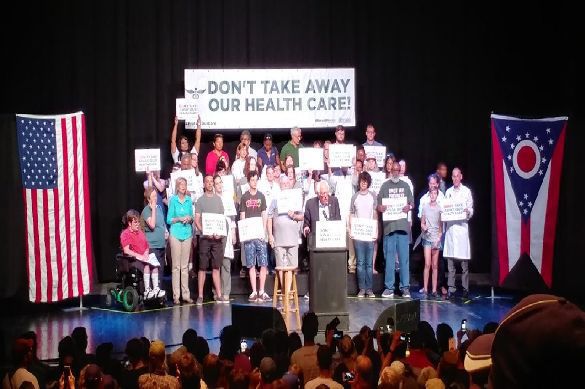
Photo: By Becker1999 from Grove City, OH - Don't Take Our Health Care Rally, CC BY 2.0, https://ift.tt/39PtBnZ

Let's block ads! (Why?)

Читать далее ...